Why Setting Boundaries Feels Like Betrayal
A client once told me she'd rather have another panic attack than tell her sister she couldn't host Thanksgiving again this year. She wasn't being dramatic. In her body, those two options genuinely felt closer in threat level than they should have. Saying no to family registered, somewhere underneath conscious thought, as a kind of danger — not inconvenience, danger.
As a therapist in Redlands, I hear versions of this constantly from women who understand, intellectually, that boundaries are healthy, and still feel something close to dread at the thought of actually holding one. That gap between knowing and feeling is exactly what this post is about.
Why a Boundary Can Feel Like a Betrayal
For a lot of women, especially those who learned early that their worth was tied to being agreeable, a boundary doesn't register as self-care. It registers as an act of disloyalty — to a parent, a partner, a friend, a whole identity built around being the reliable, easy one.
Betraying the Role You Were Given
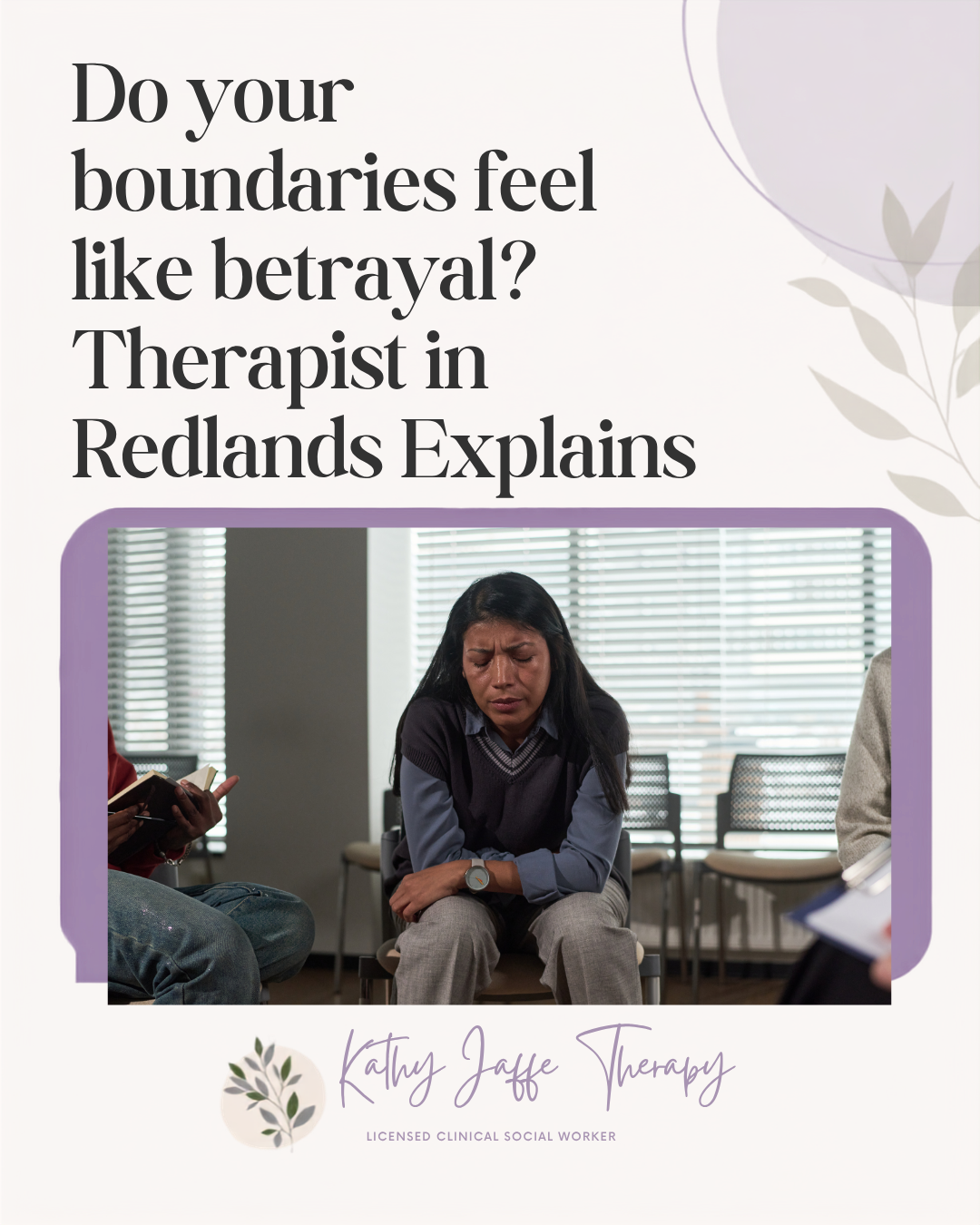
If you were the fixer, the peacekeeper, the one who never caused problems, a boundary threatens the entire role — and the belonging that came with playing it well.
Betraying the People You Learned to Protect
For women who grew up managing a parent's emotions, a boundary can feel like abandoning that person all over again, even decades later, even when the parent no longer needs managing.
Betraying the Story That You're Not “That Kind” of Person
Difficult, selfish, too much — these are the words many women fear a boundary will earn them, because somewhere along the way, someone taught them those words were the worst things a woman could be called.
Why This Fear Made Sense
I don't think this fear is irrational, and I don't think it deserves to be pushed past with willpower alone. If holding a boundary once actually did cost you something — a parent's approval, a partner's affection, a friendship — then your predictive part of the brain learned an accurate lesson from real evidence. It's not malfunctioning. It's doing exactly what it was built to do: protect you from a cost it has already paid once.
The work isn't convincing yourself the fear is wrong. It's giving your system new, current evidence that the old cost doesn't automatically apply here, now, with this person, in this relationship.
Practicing Boundaries as Evidence, Not Confrontation
Rather than treating every boundary as a high-stakes moment, I encourage clients to start small enough that the implicit memory attached to boundaries has room to update. A boundary doesn't have to be a confrontation. It can be a single sentence, held once, with someone low-stakes — and then noticed, in your body, afterward: what actually happened. Not what you feared would happen. What actually did.
Most of the time, nothing catastrophic follows. That's not a small finding. That's the beginning of teaching a very old part of you that the rules have changed.
As a therapist in Redlands, this is where I spend a lot of time with clients — not pushing you toward boundaries you're not ready for, but building the felt safety that makes them possible.
Schedule a free consultation →
Author Bio
Kathy Jaffe, LCSW is a therapist in Redlands, CA specializing in work with women navigating anxiety, trauma, relationships, and midlife transitions. She sees clients in person at her Redlands office and via telehealth throughout California. Her approach draws on interpersonal neurobiology, somatic therapy, and mindfulness-based models including ACT and DBT-informed skills — and a deep belief that your system already knows how to heal.
