
Why You Always Feel Responsible for Everyone Else's Emotions
You know the feeling.
Someone walks into the room and something has shifted in their energy — a tightness around their eyes, a flatness in their voice, a silence where there was warmth before. And before you've had a single conscious thought, something in you has already moved. Already scanning. Already calculating what happened, whether it's your fault, and what you need to do to fix it.
It doesn't matter that you were fine a moment ago. It doesn't matter that nothing has actually happened between you. Their mood has entered the room and the predictive part of your brain has already made it your responsibility.
This is one of the most exhausting ways to move through the world. And it is one of the most common patterns I see in the women I work with as a therapist in Redlands — this chronic, automatic, bone-deep sense that other people's emotional states are yours to manage.
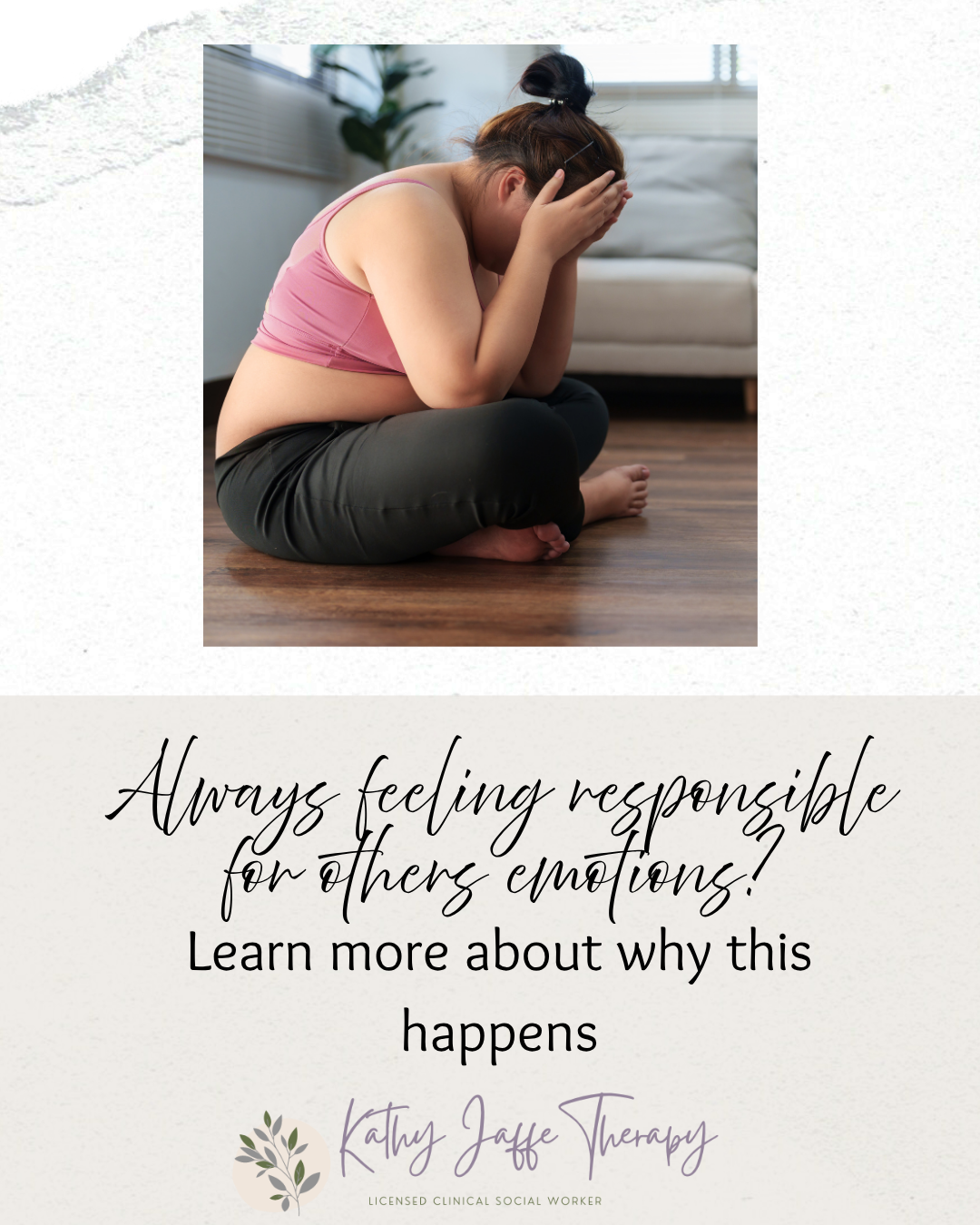
If this sounds familiar, I want you to know something important: this didn't start as a character flaw. It started as a solution.
Where This Pattern Comes From
The technical term for what I'm describing is emotional parentification — though it doesn't require a dramatic or obviously dysfunctional childhood to develop. It forms wherever a child learns, through repeated experience, that the emotional comfort of the people around them depends on the child's behavior, performance, or careful management of themselves.
This can happen in homes where a parent struggled with their own emotional regulation — where moods were unpredictable, where the atmosphere of the household shifted based on one person's internal weather, and where you learned early to read that weather and respond accordingly.
It can happen where love felt conditional — where warmth was available when you were agreeable and easy, and something withdrew when you had needs of your own or expressed difficult feelings. You learned that keeping other people comfortable was the price of connection.
It can happen more subtly — in homes that were generally loving but where one parent was anxious, depressed, or overwhelmed, and where you absorbed the unspoken message that your job was to not add to their burden. To be easy. To be fine. To manage your own distress quietly so as not to create more for them.
In all of these environments, the predictive part of your brain makes a logical and adaptive conclusion: other people's emotional states are my responsibility. If they're upset, I caused it. If they're unhappy, I need to fix it. If I can keep everyone comfortable, I will be safe.
That conclusion kept you connected. It may have kept the peace. It may have made you very good at reading people, at anticipating needs, at smoothing things over before they escalated. And it has followed you into every relationship since — not as a conscious choice but as an implicit prediction. Other people's emotional states register as your responsibility before you have had a single conscious thought about it. That is how deeply embedded these predictions become. They operate beneath awareness, faster than thought, as if they are simply the way things are.
What It Feels Like From the Inside
Because this pattern forms so early and runs so automatically, it can be genuinely difficult to recognize from the inside. It doesn't feel like a strategy. It feels like just the way you are.
Some of the ways it shows up that you might recognize:
You apologize constantly. For things you didn't do, for taking up space, for having needs, for existing in ways that might inconvenience someone. The apology arrives before you've even assessed whether you've done anything wrong — it's a reflex, not a conclusion. It is an implicit prediction firing: something is wrong and it's probably my fault.
You can't relax when someone around you is upset. Even if their mood has nothing to do with you. Even if you know intellectually that it has nothing to do with you. The predictive part of your brain doesn't care about that distinction. It learned that someone else's distress requires your intervention. You can't settle until they've settled.
You contort yourself to manage other people's reactions. You choose your words carefully. You soften difficult truths. You delay saying what you need because you're already anticipating and managing the other person's response to it. The conversation hasn't happened yet and you're already cleaning up after it.
You feel responsible for other people's happiness. Not just their comfort in a specific moment but their general wellbeing, their mood, their experience of their own lives. If someone you love is struggling, some part of you feels like you should be able to fix it — and like their struggle reflects on you somehow.
You feel guilty for having needs. Needs feel like impositions. Like you are asking for something you haven't earned. Like having them makes you difficult, demanding, or too much. This is an old prediction running — one that learned early that needs cause problems.
You feel other people's emotions in your body. Not just empathy — something more immediate than that. Their anxiety becomes your anxiety. Their tension lands in your chest. Their disapproval moves through you like something physical. The boundary between their emotional experience and yours is thin to the point of being nearly absent. This is implicit memory in action — the brain predicting, based on old information, that their distress is your emergency.
What This Costs You
The cost of chronic emotional responsibility is significant, and it compounds over time.
There is the exhaustion of it — the sheer metabolic expense of constantly monitoring everyone else's emotional weather, adjusting your behavior accordingly, and managing the relational environment so that nobody is too uncomfortable. This is full-time work. Most women doing it have been doing it so long they've forgotten they're doing it at all. They just know they are tired in a way that sleep doesn't fix.
There is the loneliness of it. Because when you are always managing how you come across — always softening, always adjusting, always performing the version of yourself most likely to keep things smooth — you are never quite fully present. And neither is anyone else, not really, because they're not meeting you. They're meeting the carefully managed version of you. Real intimacy requires a self that shows up, and chronic emotional responsibility makes that genuinely difficult.
There is the slow erosion of your own inner life. When your attention is chronically directed outward — toward other people's states, needs, and reactions — your own feelings, needs, and perceptions become quieter and quieter. Not gone. But pushed to the margins. Waiting. Some women reach a point where they genuinely don't know what they feel or what they want — not because those things aren't there, but because they've been secondary for so long.
And there is the resentment that builds underneath all of that giving. Resentment is not a character flaw. It is information. It is what happens when needs go unmet long enough. When you give and give without being asked, without being seen, without anyone noticing the cost — resentment is the signal that something needs to change.
What Begins to Shift in Therapy
The work of untangling chronic emotional responsibility is not about becoming cold, withholding, or indifferent to other people's experiences. You are a deeply empathic person. That doesn't go away. The goal is not to stop caring about other people's feelings — it's to stop being responsible for them.
That distinction, simple as it sounds, can take time to feel real in the body.
Early in this work, what often shifts first is awareness. You begin to notice the moment the prediction fires — the slight tightening, the automatic pivot toward someone else's emotional state. That noticing creates something important: a tiny gap between the old prediction and your response to it. You don't have to do anything differently yet. The gap itself is the beginning of change. Because implicit predictions only loosen when they are met with something other than what they expect — and awareness is the first step toward offering them exactly that.
From there, we work with what's underneath the pattern. The part of you that learned that other people's comfort was your responsibility. The part that still, somewhere, believes that if you stop managing everything something terrible will happen. These parts aren't wrong — they were doing important work for a long time. They just need to understand that the environment has changed.
We also work somatically — with what happens in your body when someone around you is upset. The tightening. The flooding. The way their emotional state lands in your chest before your mind has had a chance to catch up. That physical response is an implicit prediction in action — your brain anticipating, based on old information, that someone else's distress is dangerous to you and requires your immediate intervention. Learning to be with that sensation without acting on it is some of the most valuable work I know. It gives the brain new information. And new information, repeated enough times, is what changes predictions.
Over time, something loosens. The monitoring becomes less automatic. The guilt around having needs begins to soften. You start to notice what you actually feel in a given moment, not just what everyone else feels. The conversations you've been carefully managing start to become more honest — and surprisingly, often more connecting for it.
You begin to understand in your bones what it took me years of my own work to learn: that you can love people deeply without being responsible for their emotional experience. That their feelings belong to them. That your presence — your real, unmanaged, full presence — is more valuable than any amount of careful performance.
That is not a small shift. For many women it is the beginning of finally feeling at home in their own lives.
Author Bio
Kathy Jaffe, LCSW is a therapist in Redlands, CA specializing in work with women navigating anxiety, trauma, relationships, and midlife transitions. She sees clients in person at her Redlands office and via telehealth throughout California. Her approach draws on interpersonal neurobiology, somatic therapy, and mindfulness-based models including ACT and DBT-informed skills — and a deep belief that your system already knows how to heal.
