The Boundary You Can't See: Psychological Limits and Why They Matter | Therapist in Redlands
There is a kind of exhaustion that has nothing to do with how much you've done.
It's the exhaustion of a woman who has spent the day inside other people's feelings — absorbing her partner's stress, managing her mother's anxiety, soothing a colleague's bruised ego — and arrives home with no idea how she actually feels. Just empty. Scraped out. Vaguely resentful and unable to name why.
If that sounds familiar, what I'm about to describe may be one of the most useful things you read all year.
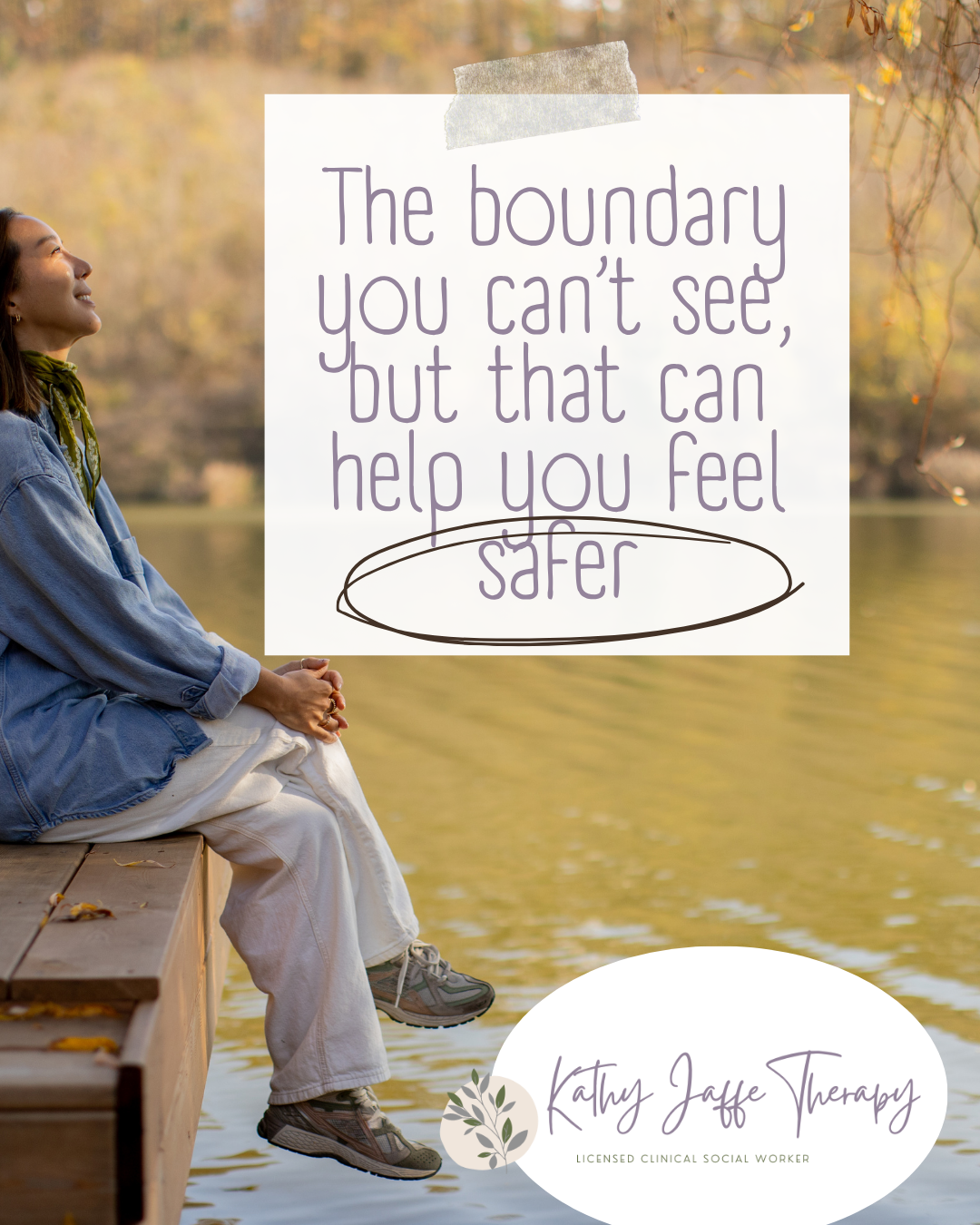
Psychological boundaries are the internal capacity to distinguish what is yours emotionally from what belongs to someone else. They don't exist in anything you say or do. They live in the quiet interior space where you know — even when someone is upset, even when someone is blaming you — this is not mine.
Why This Is So Hard for Women Who Grew Up Emotionally Responsible
Most of the women I work with as a therapist in Redlands and throughout California did not grow up learning that other people's emotions were theirs to manage. They learned the opposite.
When a parent was anxious, you learned to be calm for them. When there was conflict, you learned to disappear into helpfulness. The unspoken contract was clear: make them comfortable and you will be safe.
The predictive part of the brain absorbed all of this. It built a model where your emotional separateness was dangerous — where being a distinct person with your own internal state felt like a betrayal of the people you loved. That model doesn't disappear when you become an adult. It runs. Quietly. Shaping every moment someone looks hurt and you immediately scan yourself for what you did wrong.
How Your Attachment History Lives in Your Boundary
One of the things I find most useful in Jules' work — and that I see confirmed in my clinical practice every week — is that our attachment histories show up directly in our psychological boundaries.
If you grew up with secure, attuned relationships, you likely developed a boundary that is mostly flexible and strong: you can feel someone's pain without drowning in it, stay present with conflict without losing yourself.
If your early relationships were more anxious or preoccupied, the psychological boundary tends toward porous: you are easily moved by others' emotions, can lose your sense of self in the face of their distress, may feel a compulsive need to manage how others feel in order to feel okay yourself.
If your early relationships taught you that closeness was dangerous, the boundary can go rigid: untouched by others' emotions, dismissive of difference, unable to let much in or out.
And if your early experience was disorganized — if the people who were supposed to be safe were also frightening — the boundary may flip between porous and rigid in ways that feel confusing even to you.
None of these are flaws. They are adaptations. And they are workable.
The Two Things a Psychological Boundary Holds
The way I understand psychological boundary work — and teach it — it holds two things at once:
Compassionate witnessing. It is benevolent and respectful to bear witness to what another person is feeling — and to not try to change it. Their experience belongs to them. You don't have to fix it to care about them.
Discernment. What is actually true here? What is genuinely about me — and what isn't?
Underneath both of these is a truth that many of us resist: we have real influence in relational space. We do not have control. You cannot manage someone out of their own experience. And trying to will cost you more than you have.
The Difference Between Empathy and Merger
Empathy says: I can feel the weight of what you're carrying.
Merger says: I will carry it for you.
Empathy connects. Merger disappears you.
Many women who grew up learning to be emotionally responsible for others developed merger as their primary relational strategy. It felt like love. It was also a survival skill. The work is not to stop caring. It is to stop disappearing.
A Practice: The Belly Space
Finding Your Protective Image
Find a comfortable position. Let your attention settle in the area of your belly — below the ribcage, above the hips. This is the visceral center of the body, where a lot of implicit memory lives.
Ask that space — not your thinking mind, but your belly — to offer you an image. Something that would only let in what is true and that knows, in its bones, that it is benevolent and respectful to allow other people to have their own experience without you having to fix it.
The image might be a membrane, a screen, a body of water, a figure. It doesn't have to make logical sense. Let it come.
Then ask the image: can you hold the difference between what is mine and what is theirs?
Sit with whatever arises. This is not a thinking exercise. It is an invitation to the brain to begin building something new.
Journal Prompt
Think of a relationship where you often leave feeling worse than when you arrived. Write about:
What do I typically feel when I enter this relationship? What do I feel when I leave? What happened in between?
What would it mean — what would have to be true — for their emotional state to belong to them, not to me?
About the Author
Kathy Jaffe, LCSW is a therapist in Redlands, CA specializing in work with women navigating anxiety, trauma, relationships, and midlife transitions. She sees clients in person at her Redlands office and via telehealth throughout California. Her approach draws on interpersonal neurobiology, somatic therapy, and mindfulness-based models including ACT and DBT-informed skills — and a deep belief that your system already knows how to heal.
Ready to Go Deeper?
If something in this post landed — if you felt it somewhere before you understood it — that's worth paying attention to. Schedule a free consultation →kathyjaffetherapy.com/contact
