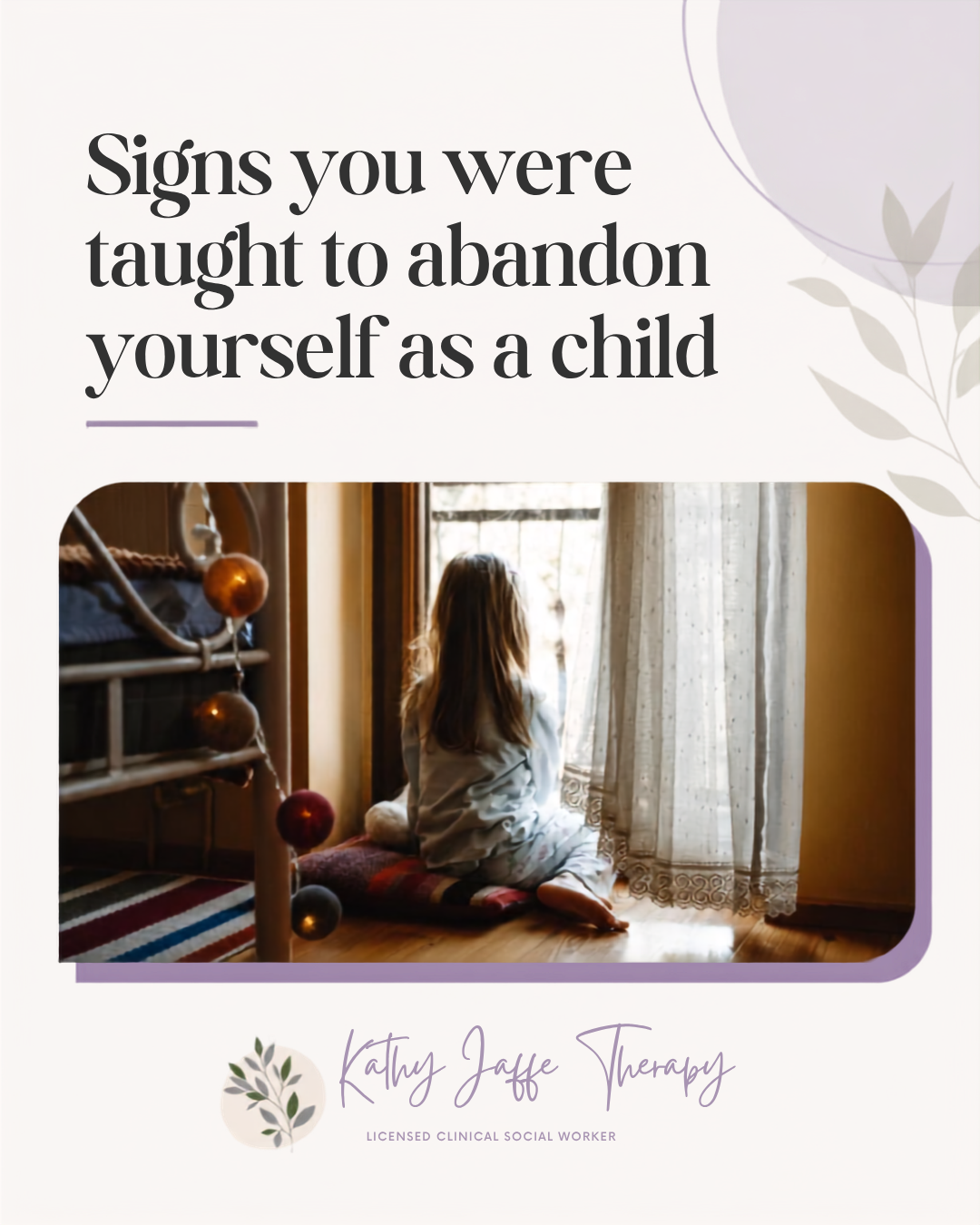
Signs You Were Taught to Abandon Yourself as a Child
I ask almost every client I work with on this pattern the same question eventually: what happened the first time you remember making yourself smaller? Most women can't name a single moment. It wasn't one moment. It was hundreds of small ones, so ordinary they never registered as anything — a look, a silence, a slightly disappointed tone — until the lesson was fully learned and you stopped needing anyone to teach it to you again.
As a therapist in Redlands, I spend a lot of time with women untangling where this started, not to assign blame, but because naming the origin is often what finally makes the pattern feel less like a personality flaw and more like what it actually was: something you learned, young, to survive an environment as it was.
What Childhood Self-Abandonment Actually Looked Like
Self-abandonment rarely starts with anything dramatic. It starts with a child noticing, correctly, what got a caregiver's approval and what didn't — and adjusting.
Being Praised for Being “No Trouble”
If the version of you that needed nothing, complained about nothing, and required no extra attention was the version that got called good, easy, low-maintenance — you learned early that your needs were, at best, tolerated, and at worst, a burden.
Becoming Fluent in Other People's Moods
Children in unpredictable emotional households often become extraordinary at reading a room before they've even walked into it — because their safety depended on knowing, instantly, what mood they were about to encounter. That hypervigilance doesn't switch off just because you grew up. For a lot of women, this becomes a real point of pride — a skill they're genuinely good at, not just a defense they fell into. That's worth honoring. The part that goes unexamined is what it costs to run that skill without ever learning where your own feelings are allowed to start.
Being the Emotional Support for a Parent
Some children learn to manage a parent's feelings — a mother's sadness, a father's anger — long before they have any business carrying that weight. When a child becomes responsible for an adult's emotional state, self-abandonment isn't a choice. It's a job description.
Getting the Message That Anger Wasn't Safe
Whether it was punished outright or simply never modeled as something to express cleanly, many women learned that anger — even reasonable anger — was dangerous to show. So it went underground, and the accommodating, agreeable self came forward instead.
Why This Was the Right Call at the Time
I want to be clear about something: if this was your childhood, the version of you that adapted this way was not weak. She was resourceful. A child's job is not to advocate for their needs against an environment stacked against them — it's to survive that environment by whatever means available. Shrinking, accommodating, becoming what the household needed you to be — that was a smart, protective strategy built by a child with very few other tools.
The problem was never that you built this. The problem is that implicit memory doesn't automatically update just because your circumstances have changed. The part of you that learned self-abandonment was safe at seven is often still running the same program at thirty-seven, in rooms and relationships that no longer require it.
Recognizing the Pattern Now
If any of this is landing, I don't want you to receive it as an indictment of your childhood or your parents necessarily — plenty of loving, well-intentioned families still raise children who learn to abandon themselves, often because the parents learned the exact same lesson themselves. This isn't about blame. It's about recognizing that a predictive part of your brain built its rules a long time ago, under different conditions, and it's allowed to update them now.
As a therapist in Redlands, this is often where the work actually begins — not with trying harder to set boundaries in the present, but with understanding, with real compassion, why the part of you that avoids them learned to do that in the first place.
Schedule a free consultation →
Author Bio
Kathy Jaffe, LCSW is a therapist in Redlands, CA specializing in work with women navigating anxiety, trauma, relationships, and midlife transitions. She sees clients in person at her Redlands office and via telehealth throughout California. Her approach draws on interpersonal neurobiology, somatic therapy, and mindfulness-based models including ACT and DBT-informed skills — and a deep belief that your system already knows how to heal.
