Containing Boundaries: How to Stay True to Yourself When You're Flooded | Therapist in Redlands
In the last post, we worked with psychological boundaries — the invisible internal capacity to know what is yours emotionally and what belongs to someone else. We talked about the belly space, the protective image, the difference between empathy and merger.
This post lives right next door to that one.
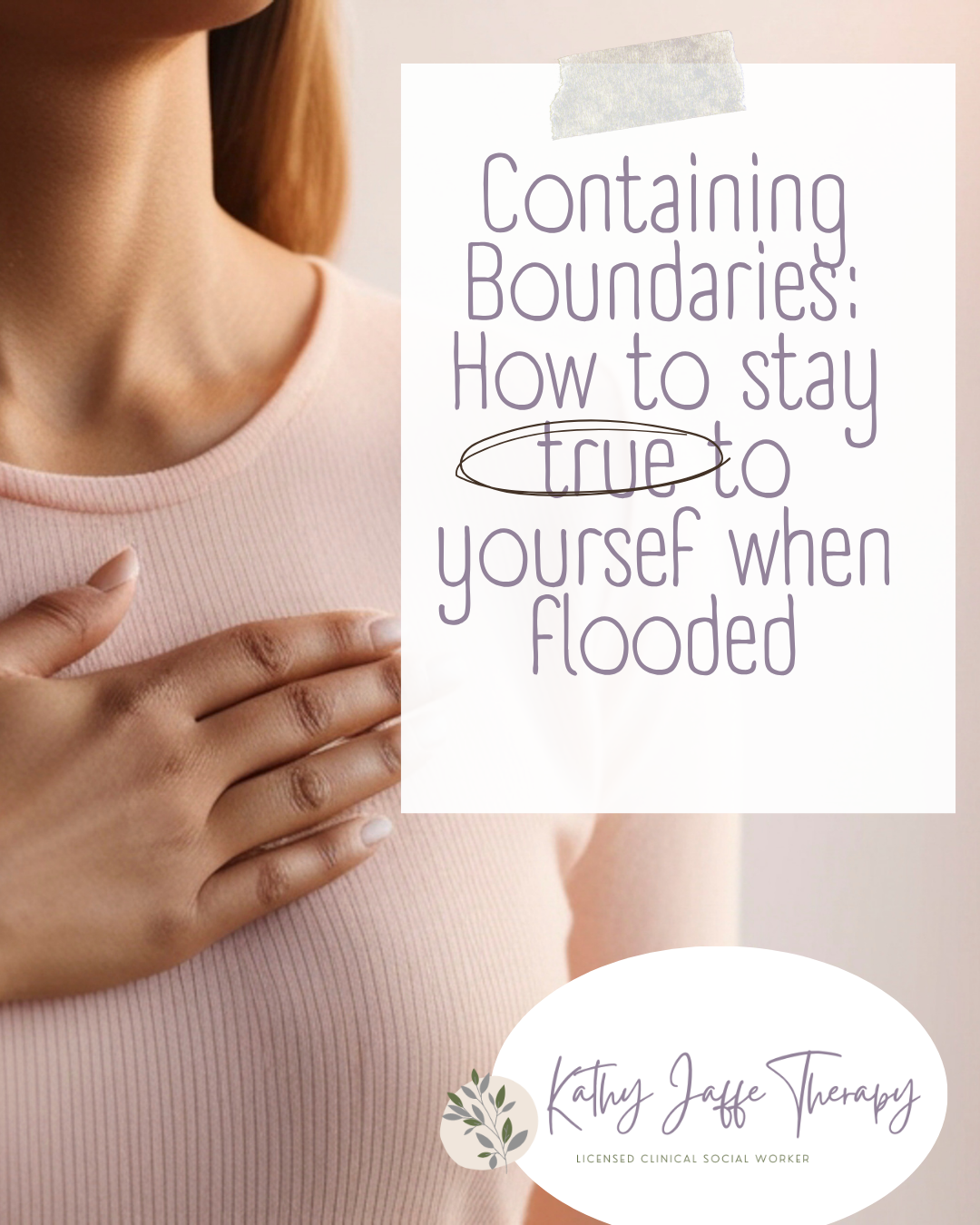
Because here's what I've noticed in my practice as a therapist in Redlands: psychological boundary work and containing boundary work often need each other. When you lose your psychological boundary — when someone else's emotional state floods into yours — the next thing that tends to happen is that you react from that flooded place. You say the thing you'll wish you hadn't. You go silent in a way that isn't peaceful. You do the version of yourself that you'd prefer nobody saw.
Containing boundaries are the practice that lives in that space. They are the limits you set on how you act out your emotional state — not to suppress what you feel, but to protect your relationships and yourself from the part of you that moves faster than your values can catch up.
There Is a Version of You That Exists Only When You're Flooded
She says things she regrets. She sends emails at 11pm that she wishes she could recall. She goes cold when she means to be warm, or sharp when she's really just scared. She is not a bad person. She is a person whose predictive brain took over before she could think.
I think most of us have a version of her. I certainly do.
And I want to say something about her before we go further: she is not a flaw. She is the part of you that learned, in some earlier context, that speed was survival. That you had to react before you had time to think because thinking took too long and the situation didn't wait. She was doing her best then. She is still trying now.
The work is not to get rid of her. It is to build enough of a pause that you get to choose whether she speaks.
This Is Not About Suppressing Your Feelings
So many of the women I work with have spent a lifetime swallowing their feelings to keep the peace. Containing boundaries are not that. I want to be clear about this because the distinction matters.
Suppression says: push it down, don't let it show, act fine.
A containing boundary says: I feel this fully — and I am choosing how and when and where I express it, so that I stay aligned with who I want to be.
The feeling is not the problem. The unconstrained acting-out of the feeling is.
There is a difference between feeling furious and sending the furious email. Between feeling hurt and saying something designed to wound. Between feeling overwhelmed and picking a fight about something small because the real thing feels too hard to name. Containing boundaries live in that space — the gap between feeling and action — and they widen it, slowly, through practice.
Why the Predictive Brain Makes This So Hard
When implicit memory gets activated — when something in the present triggers a stored prediction from the past — the response can feel instantaneous. Overwhelming. Like there's no space between the feeling and the action at all.
That's not weakness. That's how predictions work. The part of the brain that generates them moves faster than the part that thinks. It's trying to protect you based on what it has learned worked before.
What we can build — slowly, through repeated new experience — is a wider gap. Not through willpower. Not through deciding to be different. Through enough moments of pausing, feeling the flood, and choosing something other than the automatic response that the brain begins to update its prediction of what is possible.
Each one of those moments is data. New data. The kind that actually changes things.
Before You're in the Flood: Finding Your Anchor
In Post 2, when we walked through the process of setting external boundaries, I introduced a practice for finding an integrity word and a compassion gesture — an internal anchor you can return to when fear kicks in during a hard conversation.
Those same tools are the foundation of containing boundary work. If you didn't do that practice yet, or if you want to revisit it before going further, here it is again. This time, hold it specifically in the context of the flooded moments — the ones where you act from a version of yourself you don't want to be.
Finding Your Integrity Word and Compassion Gesture
Your Integrity Word
Picture yourself in a moment where you showed up as the wisest version of yourself. Hold that image. Then list five words that describe that person:
1. _____________________________________________
2. _____________________________________________
3. _____________________________________________
4. _____________________________________________
5. _____________________________________________
Now find one word that holds all five: _____________________________________________
Next: take a mental snapshot of yourself in a really good moment as a caregiver — with a child, student, younger family member, or pet. Then one in a really good moment with a peer or close friend. Then one with a stranger or acquaintance.
What word or image captures the essence across all three? _____________________________________________
Your Compassion Gesture
Is there a small physical gesture — a hand to your heart, a grounding touch, a slow breath with intention — that can bring you back to both of these words when you need it most?
Commit to using it often, many times a day if you can, for three to four weeks. The goal is for it to become a body memory — something the brain reaches for automatically in the moments when you most need to come home to yourself.
What Containing Boundaries Look Like in Practice
They rarely look dramatic. Most of the time, they look like:
Saying "I need a few minutes" before responding to something that landed hard.
Texting a friend instead of the person you're in conflict with.
Going for a walk — not to escape the feeling, but to let it move through your body before you speak.
Writing the email, saving the draft, reading it again in the morning.
Staying in the room but going quiet — genuinely pausing, not stonewalling — until you can find words that belong to the person you want to be.
None of these are complicated. All of them are harder than they sound when you're flooded. Which is why the anchor matters — you build it before you need it, so it's there when you do.
Practice: The Pause
When You Feel the Flood Coming
When you notice it — the chest tightening, the tone sharpening, the urgent need to say the thing right now — try this:
Use your compassion gesture. Whatever you chose: the hand to your heart, the grounding touch, the breath. Let it be the first thing, before anything else.
Say your integrity word silently to yourself. Not as a command — as a return. As a reminder of who you are when you are most yourself.
Then orient to the present moment: feet on the floor, weight in the chair, breath through the nose.
Ask yourself: is this the version of me I want to show up as right now?
Then decide. You can still feel everything. You can still speak. You just get to choose from the inside out — not from the flood.
Journal Prompt
Think of a recent moment where you acted from the flooded version of yourself and wished you'd done it differently. Without self-judgment:
What was activated? What were you actually feeling underneath the reaction?
What did you want the other person to understand — and what would have been a truer way to say it?
Where in your body did you feel the flood first? Is there an earlier signal — something that comes before the full surge — that you could learn to notice?
A Note on Repair
Sometimes you'll pause. Sometimes you won't. Sometimes the flooded version of you will say the thing before you had a chance to find your word, your gesture, your ground.
This is not failure. This is being human in a body that learned to move fast.
What matters — what actually builds new implicit memory — is what you do afterward. Whether you come back. Whether you name what happened. Whether you repair, with the other person and with yourself.
Repair is not weakness. It is the most sophisticated relational skill there is. And it is itself a form of containing boundary — the choice to stay in integrity even after the moment where you lost it.
About the Author
Kathy Jaffe, LCSW is a therapist in Redlands, CA specializing in work with women navigating anxiety, trauma, relationships, and midlife transitions. She sees clients in person at her Redlands office and via telehealth throughout California. Her approach draws on interpersonal neurobiology, somatic therapy, and mindfulness-based models including ACT and DBT-informed skills — and a deep belief that your system already knows how to heal.
Ready to Go Deeper?
If something in this post landed — if you felt it somewhere before you understood it — that's worth paying attention to. Schedule a free consultation
